Transforming Victoria’s Future WIth Less Waste
Victoria’s Container Refund Scheme (CDS) and targeted plastic bans have already proven their value. Over 3.7 billion containers have been collected for recycling in just three years, driving a 71% reduction in container litter across the state.
However, the job is far from finished. Container return rates in Victoria still lag behind other states, and single-use packaging continues to pollute our environment. According to the latest Clean Up Australia reports for Victoria, items such as bottle tops, soft plastics and non-food packaging now account for over 60% of local litter.
These challenges are entirely fixable. As Victoria prepares for its next term of Parliament, the Boomerang Alliance, Australia’s leading community advocate for container refund schemes, is calling on political leaders to step up and build on this momentum.
5 Actions for the Next State Government
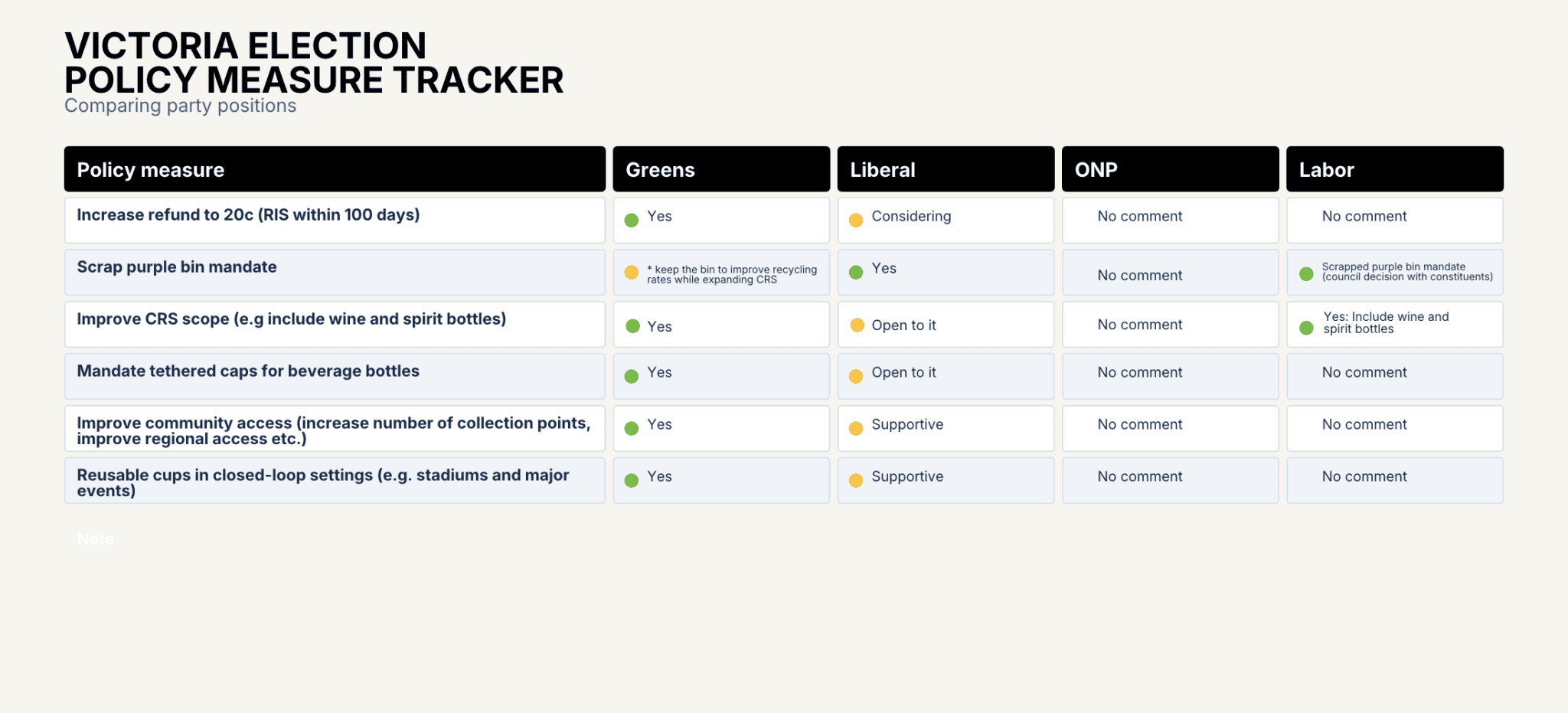
- Increase the Container Refund to 20 Cents: Double the financial incentive to boost community participation and bring Victoria in line with best practices.
- Expand the Scheme’s Scope: Include wine and spirit bottles, milk, and juice containers in the CDS, and mandate tethered caps on all beverage bottles to eliminate loose lid litter.
- Mandate Reusables at Major Venues: Require all major stadiums, festivals, and public events to offer reusable cups and food containers to patrons as they do in Europe.
- Phase Out Remaining Problem Plastics: Ban single-use plastic produce bags and mini soy sauce fish, while establishing durability standards for reusable shopping bags.
- Drive National Producer Responsibility: Support a unified national packaging framework that holds manufacturers accountable, while fast-tracking a national soft plastics collection system.
Other key priorities
- Oppose thermal waste-to-energy plants and restrict the expansion of existing ones.
- Improve circular economy legislation similar to the NSW Plastics Plan 2.0 to enable product stewardship for items such as batteries, cigarette butts, e-waste and more. These items are causing needless pollution to our local environment, and items like batteries can cause an uncontrolled fire risk or are unable to be recycled or reused.
- Adopt a microplastic reduction strategy with compliance powers targeting the range of sources for elimination and pollution control, and regular monitoring of water, air, soil and foreshore environments.
- Continue to provide funding for litter clean-ups and macro- and microplastic monitoring to keep the community safe.
How does your party stack up?